Home / Projects / Zangdok Palri

༈ ཟངས་མདོག་དཔལ་རིའི་ཕོ་བྲང་ཆེན་མོ།

Zangdok Palri, the Glorious Copper-Colored Mountain

The pure land of Guru Rinpoche, a palace that is itself a teaching, and a temple now rising in its image at Dundul Raptenling Monastery in Odisha, India.

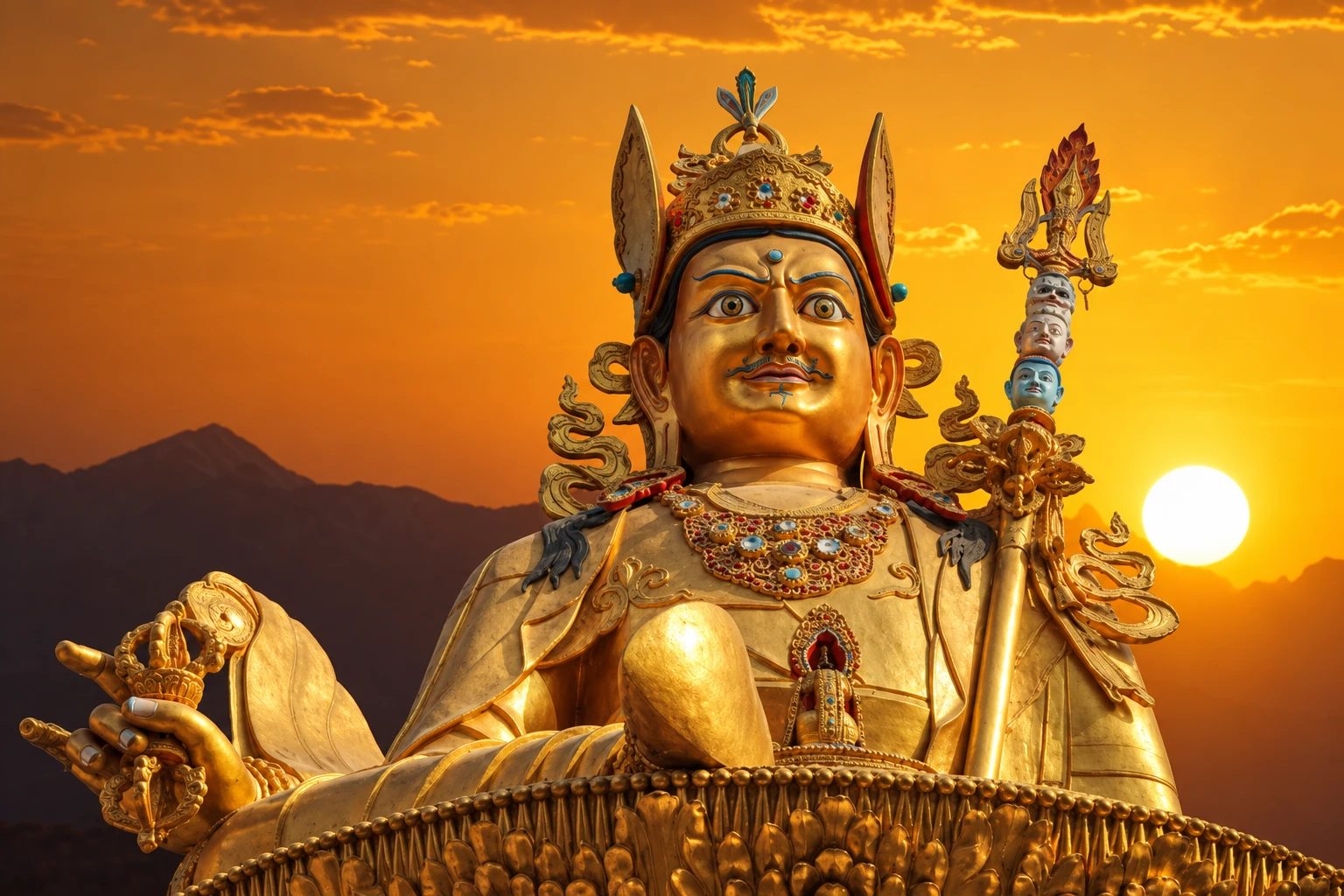
Golden statue of Guru Padmasambhava against a sunset sky over the mountains

01The name

A mountain the color of copper

In Tibetan, Zangdok Palri (zangs mdog dpal ri) means “the Glorious Copper-Colored Mountain.” Zangdok is the deep red-gold of copper; palri is “glorious mountain.” Practitioners often call it simply the Glorious Mountain.

It is the pure land of Guru Padmasambhava, the Lotus-Born, whom Tibetans call Guru Rinpoche, “Precious Master.” In the eighth century he brought the Vajrayana teachings to Tibet, and the Nyingma tradition, the oldest school of Tibetan Buddhism, traces its lineage to him.

02The story

Where Guru Rinpoche went when his work in Tibet was done

The tradition tells that when Guru Rinpoche had established the Dharma in Tibet, he did not simply leave this world. He turned to the southwest, to Chamara, an island at the edge of our world inhabited by rakshasas, fierce beings who threatened human life.

There he tamed the rakshasa king and, on the summit of the copper-colored mountain at the island’s center, manifested the Palace of Lotus Light, Pema Ö. What had been a land of fear became a place of awakening. Guru Rinpoche did not pass away; the tradition holds that he remains there still, teaching, and sending emanations into the world wherever beings call on him.

Devotees say that Guru Rinpoche has never left. He is as near as a sincere prayer.

03What a pure land is

Not only a place, but a way of seeing

A pure land is a realm where everything, the ground, the light, the sound, turns the mind toward awakening. The masters explain that a pure land is not only somewhere far away: it is how the world appears to a mind free of confusion. As our perception is purified through practice, the Copper-Colored Mountain comes closer.

For this reason, practitioners of the Nyingma tradition make aspiration prayers to be born in Zangdok Palri and to meet Guru Rinpoche face to face. These prayers are recited daily in monasteries and homes, and with special devotion on Guru Rinpoche Day, the tenth day of each lunar month.

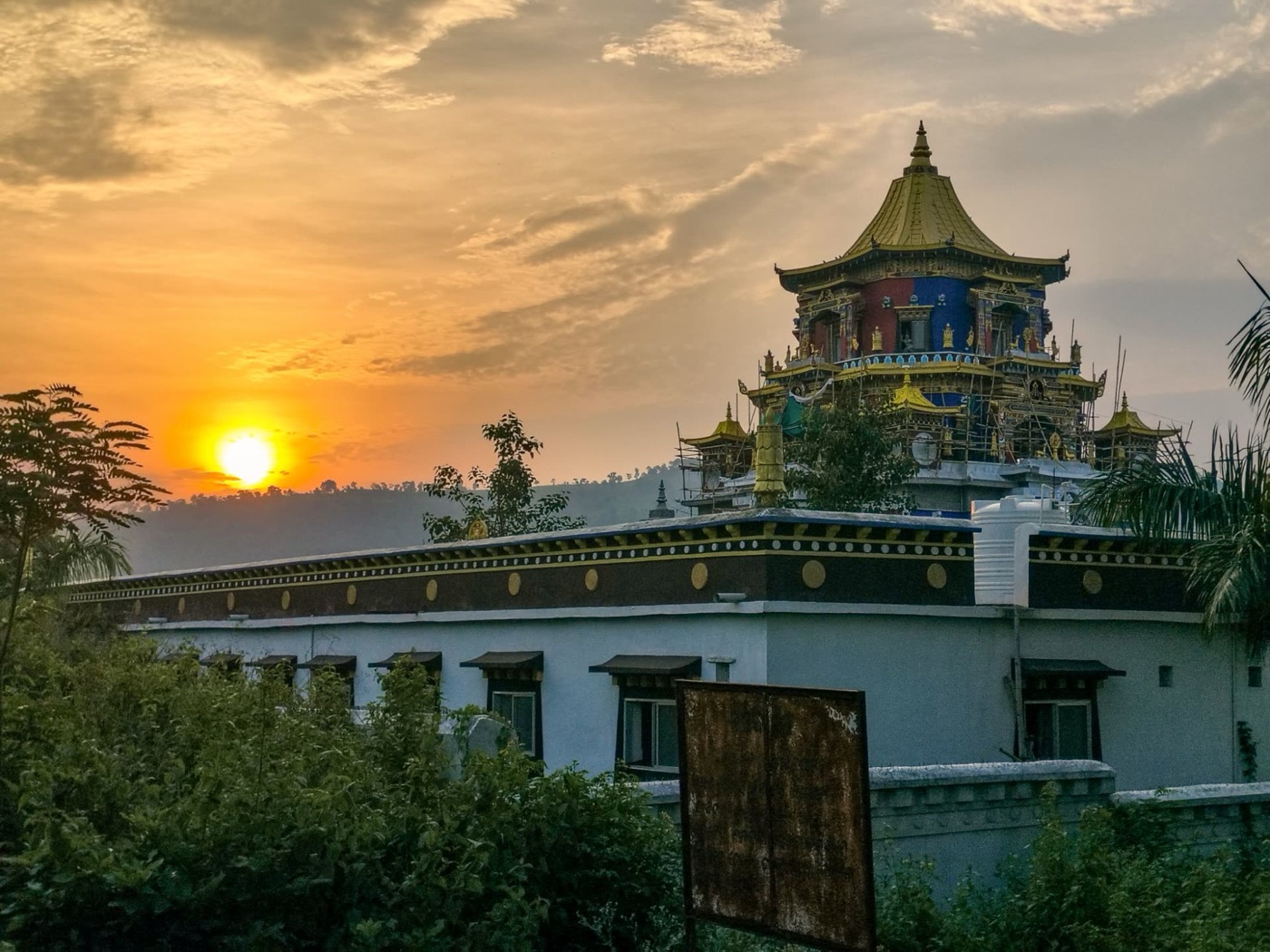
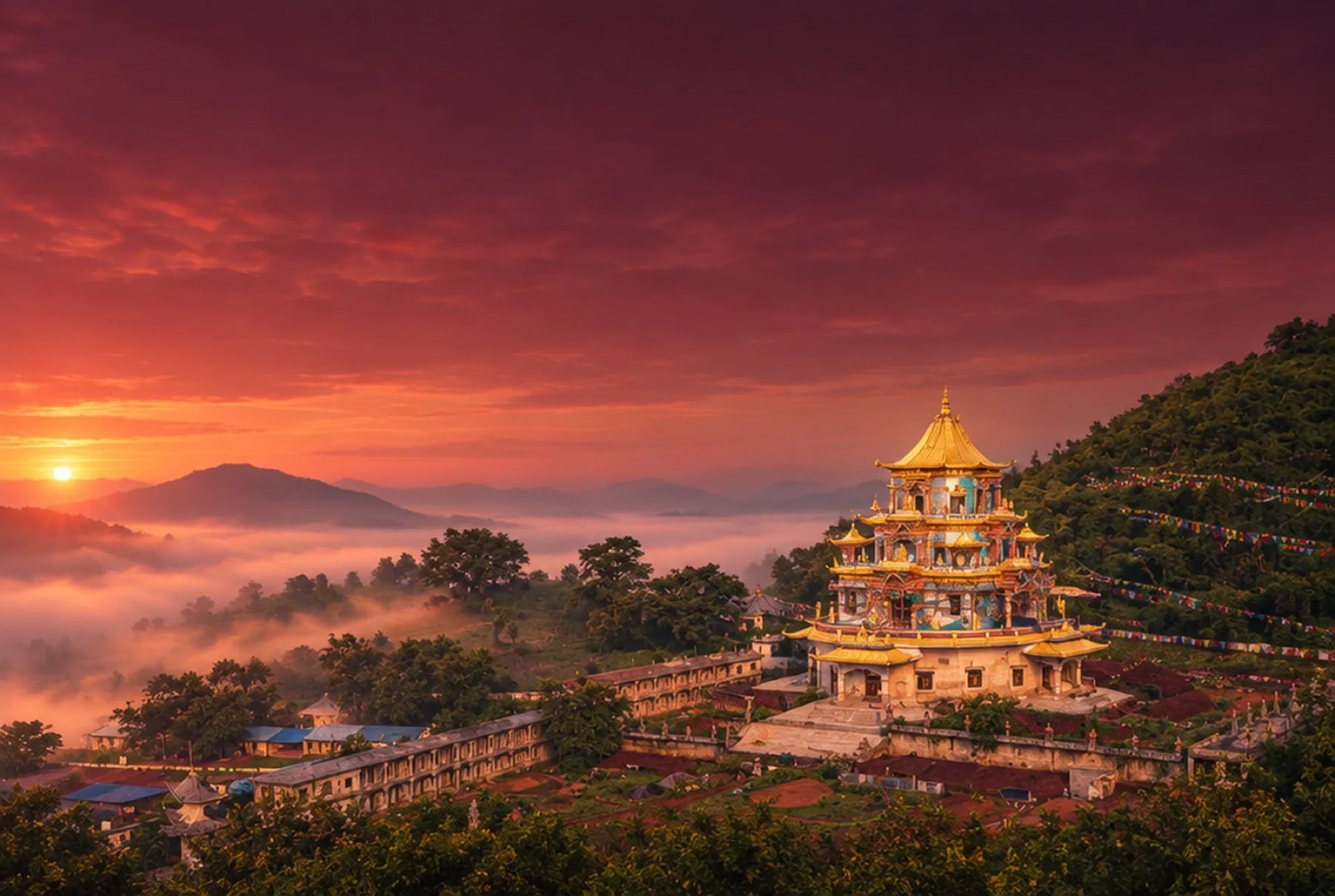
Zangdok Palri temple at sunset, its golden roof against the evening sky

04The palace as teaching

Three storeys, three bodies of enlightenment

The Palace of Lotus Light is described in the treasure teachings in great detail, down to its gates, ornaments and offering goddesses. At its heart are three storeys, and each storey is one of the three kayas, the three bodies of enlightenment.

  • Ground floor, Nirmanakaya, the emanation body: Guru Padmasambhava himself, enlightenment in a form that enters the world and can be met.
  • Middle floor, Sambhogakaya, the body of perfect enjoyment: Avalokiteśvara, enlightenment as radiant light and boundless compassion.
  • Summit, Dharmakaya, the truth body: Amitābha, Boundless Light, enlightenment beyond all form.

To walk up through Zangdok Palri is to make a journey of the mind: from a teacher we can see, to compassion we can feel, to a wisdom beyond all form. The building is the path.

05Visions of the masters

Those who have seen it

Over the centuries, great masters have described journeys to the Copper-Colored Mountain in visions and dreams, and their accounts became the basis for paintings, prayers and temples. The fifteenth-century treasure revealer Pema Lingpa described being received by Guru Rinpoche in a palace of jewels. Other masters recorded meadows, lakes of nectar and trees that grant every wish: the landscape that Tibetan painters have tried to capture ever since.

06Why temples are built in its image

Making the pure land visible

Because Zangdok Palri is described so precisely, it can be built. Across the Himalayas, in Tibet, Bhutan, Nepal and India, communities have raised temples in its image, so that the pure land can be seen, entered and honored in this world.

The tradition teaches that a connection made with such a temple is never wasted. Seeing it, walking around it, offering a lamp or a flower, or simply hearing of it plants a seed of liberation. A Zangdok Palri temple is a mandala you can walk into.

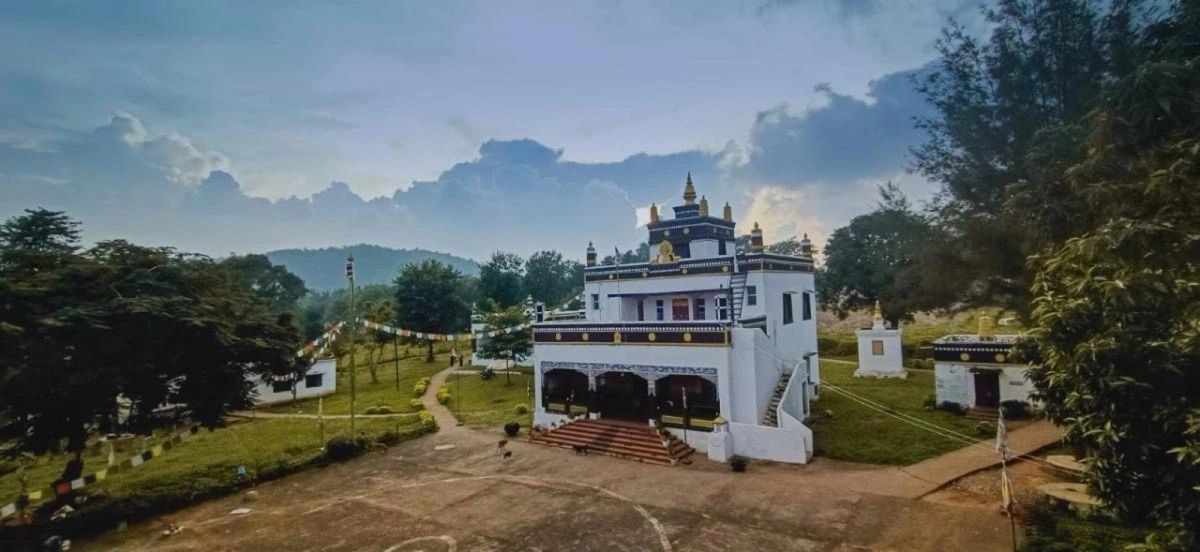
Dundul Raptenling Monastery among green hills in Odisha

07The Dudjom lineage

Zangdok Palri and the Dudjom Tersar lineage

“Whoever has connections with him (H.H. Dudjom Rinpoche) will be taken to Ngayab Ling (Zangdok Palri).”
— Prediction by Urgyen Dechen Lingpa

In Tibet, before 1959, His Holiness Dudjom Jigdral Yeshe Dorje founded Rigzin Ghatseling Monastery at Buchu in Kongpo, along with the first Lama Lingpa community. His disciples there included accomplished masters, great ngakpas and fully ordained gelongs, and the Dudjom Tersar lineage thrived.

After 1959, Tibetans lost their homeland and came to India as refugees. In those years of exile, His Holiness saw that a new monastery was urgently needed if the Buddha’s teachings were not to decline. His Holiness the 14th Dalai Lama, wishing to safeguard the Nyingma lineage, asked Kyabje Dudjom Rinpoche Jigdral Yeshe Dorje to become Supreme Head of the Nyingma tradition.

For the new monastery, Kyabje Dudjom Rinpoche chose Odisha: the Hevajra Tantra names it among the Twenty-Four Great Sacred Places, and it is held to be the celestial abode of Oddiyana. Dundul Raptenling Monastery was founded there in 1963, and it became the seat of the Dudjom Tersar lineage in Odisha.
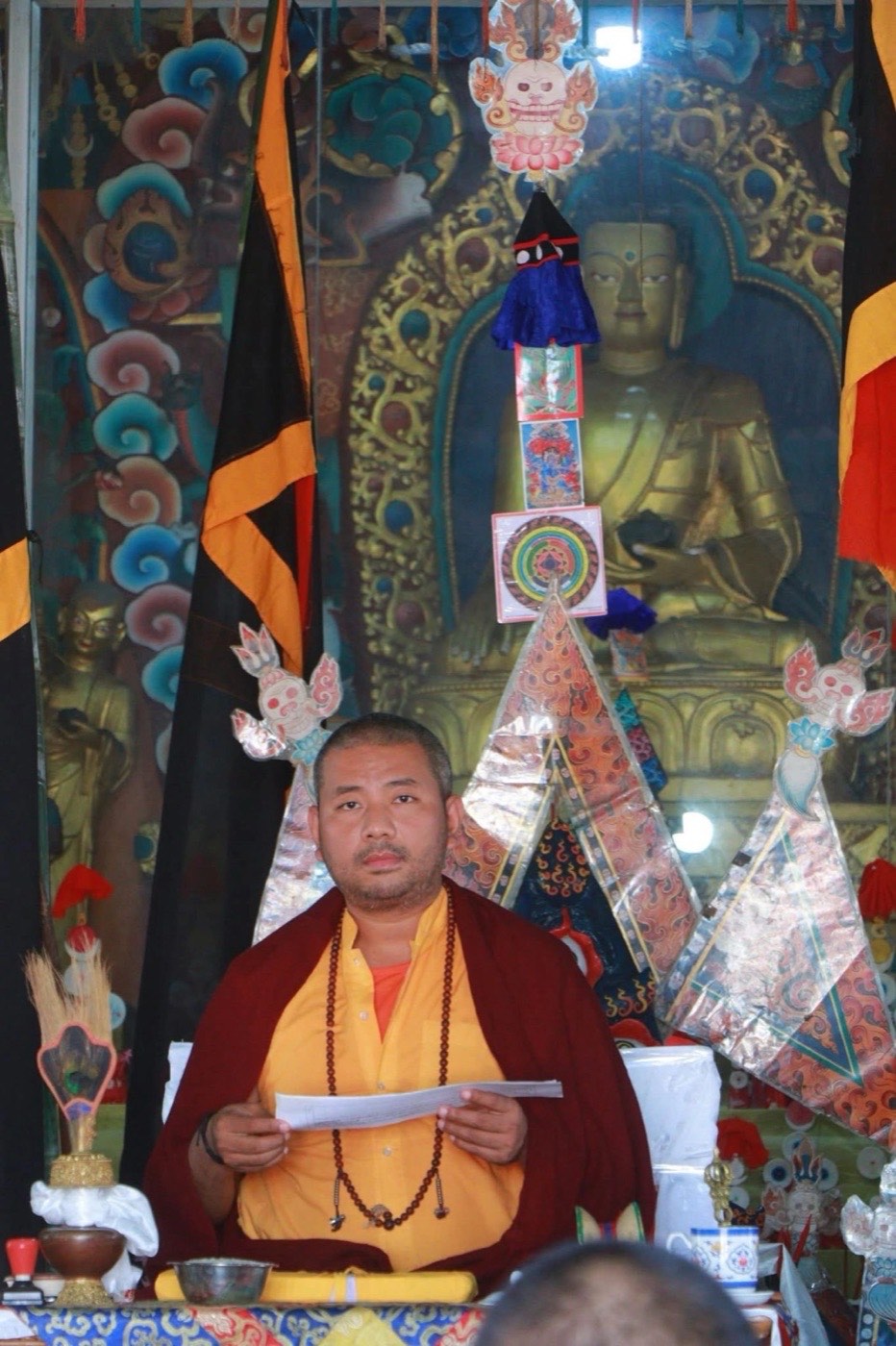
Lama Sonam Tashi Rinpoche in maroon and yellow robes

08The temple in Odisha

A pure land rising at Dundul Raptenling

Lama Sonam Tashi Rinpoche, President of Dundul Raptenling Monastery and a founding director of Vajra Lotus Foundation, has guided the monastery since 2010. More than one hundred young monks now live, study and practice there. Seeing that the monastery’s old buildings could not serve the generations to come, and out of devotion to Guru Rinpoche and the lineage masters, Rinpoche began building a three-storey Zangdok Palri temple.

Design began in 2016, the Fire Monkey year, and ground was broken in 2017. Today the temple is more than 80% complete: the foundation and outer structure stand, and the final work of sacred statues, murals, painting and gardens is under way. It will be consecrated in March 2028, the Earth Monkey year, a year associated with Guru Rinpoche, in a gathering of lineage masters, the monastic sangha and pilgrims from around the world.

An invitation

Make your connection with the Copper-Colored Mountain

However you come to Zangdok Palri, the connection matters.

Vajra Lotus Foundation is a U.S. 501(c)(3) nonprofit, EIN 36-5143055, that supports Dundul Raptenling Monastery. Donations are tax-deductible to the extent allowed by law.